Fauna i fraseologia sempre han anat de la mà en l’estructura lingüística de la societat. En trobem exemples abundants des de les velles rondalles, passant per les llegendes populars, fins arribar als primers contes clàssics. En la tradició oral i el folklore i, amb ells, en els refranys, aforismes i sentències, abunden les criatures animals com a protagonistes per revelar-nos les passions pròpies de l’ésser humà. No hem d’oblidar que les dites, modismes, frases fetes, etc., componen una part importantíssima de la glotodidáctica d’un idioma. No conèixer-los limita l’assimilació lèxica i interfereix en la competència comunicativa, i per tant, no poden ni han de ser omesos en l’ensenyament d’una llengua.
És d’això, d’expressions idiomàtiques en anglès inspirades en el món animal del que parlarem en aquest espai. Per il·lustrar el contingut gramatical que tractarem, vam partir del propi castellà i del seu clàssic literari més rellevant, universal, i eminent. Arrenquem, així, amb una sentència de Sancho Panza, prolix en refranys, qui ens adverteix: “més val ocell en mà que voltor volant.”
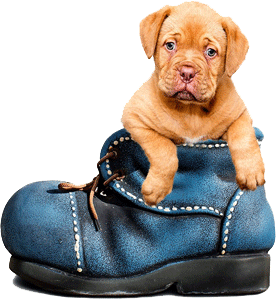
There are many idioms in English which have animal representation. Some of the meanings of these idioms are quite obvious, whilst others may be very strange and difficult to understand for the average language learner. Here are some of the more popular ones.
Straight from the horse’s mouth – This means directly from the original source of the information. For example –
“Where did you hear the story about John leaving?”
“He told me. I got it straight from the horse’s mouth.”
This means that John told him the story directly. He didn’t need to get the story from another source.
Let the cat out of the bag – This means to tell a secret. For example –
“Barca wanted to keep the player transfer a secret, but a reporter found out about it and let the cat out of the bag.”
This means that Barca had made a transfer in secret and wanted it to remain that way, but a reporter had discovered the information and released it to the public.
A copy cat – This means someone who copies everything that someone else does. For example –
“Dana always does everything her sister does. She is such a copy cat.”
This means that Dana never does anything original. She always follows what her sister does.
In the dog house – If you are in the dog house, it means you are in trouble. For example –
“Mascherano won’t get a game for a while. He is in the dog house with Luis Enrique.”
This means that Javier Mascherano must have done something to annoy Luis Enrique and now he is in trouble and is being given a punishment, specifically not being allowed to play.
Horsing around – This means to be having fun or making a joke. It can also mean to play roughly. For example –
“Don’t worry about the kids. They are not fighting. They’re just horsing around.”
This means that although it may look like they are being rough with each other, they are really just having a bit of fun.
Hold your horses – This means to be patient and wait. For example –
“Just hold your horses. Dinner will be ready in five minutes.”
This basically means to be patient as dinner will not be very long.
Pig out – This means to eat a lot of food in one sitting. For example –
“I can’t believe I ate so much tonight. I really pigged out.”
This means that you ate so much that you are probably going to look as fat as a pig in the morning.
As you can see, there are many idioms that have animals in them and are in common use in English. If you do not completely understand what someone means when they use one of these idioms, I am sure that they would not mind explaining it to you if you asked them.
Good luck figuring out what some of them mean though. They can be tricky.
K. Charles

Vine a conèixer l'escola i fes una prova d'anglès gratuïta
- “Delexical Verbs”
- “Primary Auxiliaries And Modal Auxiliaries”
- “Word Order”
- “Phrasal Verbs with ‘Put’”
- “The Difference Between Reflexive Pronouns and Emphasising Pronouns”